Tuesday, March 30, 2010

M. Night Shyamalan misses the point


M. Night Shyamalan on Racial Diversity in The Last Airbender


For those of us waiting for M. Night Shyamalan to address our concerns about the discriminatory casting in The Last Airbender, this latest article on ugo.com reveals some of his thinking on the matter. Unfortunately, it seems he really doesn't understand why everyone's so upset.

One good thing is that he admits that he's heard about the protest. But to respond to our calls for people of color as heroes, he simply points to the racial indeterminacy of anime -- as if that justifies the casting of only "European"-featured heroes. He completely neglects to mention that they specifically cast for white actors, instead implying that they were really trying to populate their world with a mix of races. Which would be hard to do with the casting announcement for "Caucasian or any other ethnicity."

He also states, "Maybe they didn’t see the faces that they wanted to see but, overall, it is more than they could have expected. We’re in the tent and it looks like the U.N. in there." False. We expected to see people of color as the heroes, rather than as the background actors and the villains, so we are not getting even close to these expectations. Also, if he were true to his metaphor of the U.N., he would have sat people of color at the table next to white people, as equals.

Finally, when prodded about how "the only characters of color are baddies," he responds "It's called irony." It's hard to read this remark since it doesn't make any sense, but the most disappointing thing is that he truly doesn't seem to take this critique seriously.

Kudos to Jordan Hoffman for getting responses to these "touchy" questions (except for the conspiracy theorist comment...), and a big thumbs down to M. Night Shyamalan for failing to respond appropriately.


Tuesday, March 23, 2010

Working your way up in TV: An Entertainment Career Workshop

For recent college graduates and early-career individuals:

You're invited to the annual Academy of Television Arts & Sciences Diversity Committee Career Workshop on the evening of April 19th. The event will be at the TV Academy, with check-in from 6:00 - 7:30pm. Event will start at 7:30pm and proceed until 10:00pm.

WHO SHOULD ATTEND
Entry-level people who are aspiring to become Network & Studio Executives, Producers, Agents, Writers, Directors, Production Staff; anyone seeking entry-level positions including PAs, assistants, interns, and those trying to move up the ladder. Come in business attire and bring a pen and notepad in a leather portfolio.

Our goal is to get new folks into the system, train them and nurture them toward a successful entertainment career and build more fresh creative voices which ultimately impact society.

MONDAY, APRIL 19, 2010
7:30 - 10:00 PM

ACADEMY OF TELEVISION ARTS & SCIENCES
Leonard H. Goldenson Theatre
5230 Lankershim Blvd.
North Hollywood, CA 91601

RSVP to: atascareerworkshop@yahoo.com

Thursday, March 18, 2010

Join us online!

MANAA finally jumped on the new media/social software bandwagon (hey, it's never too late right?)...join us on Twitter and Facebook! We promise to have exciting updates on everything that we're doing. Join us and get in on the action!

Friday, February 05, 2010

50 Most Racist Movies


This list of the 50 Most Racist Movies in Complex magazine is pretty great. Of course, we disagree with the subtitle "you didn't think were racist," since MANAA's long been busy pointing out the racism in movies like Dragonball, 21, The Last samurai, 16 Candles, and of course number one on the list Breakfast at Tiffany's.

But it's always great to see a compilation like this. Reminds us all that racism is indeed systemic in our culture and particularly in the media, surrounding us daily with images that are stereotypical and problematic. Check out the list and then think about how many more movies could be added to the list every year. Staggering, isn't it? Most of all, we just agree with the list's imperative -- "Turn on your racist radars, people!"

Monday, February 01, 2010

Seeing ourselves in the media

If you're on Facebook, you might have noticed that your friends have lately been changing their profile picture to "their celebrity doppelganger." Something you might NOT have noticed is that people of color haven't really been playing along. Why not? Maybe because when they try to think of celebrities who look like them, the list is just too small. While most white people can think of a celebrity who shares their hair color and length, the shape of their eyes, their smile, it's much less likely that all of your Asian friends happen to look like Lucy Liu, Sandra Oh, or John Cho. What are the odds, really?

Yet another moment when we realize that something is missing from our media landscape -- the faces of people who look like us and our friends. As it is, most Asian people have probably been told that they DO look like Lucy Liu or Sandra Oh, even if they look nothing like them (all look same right? wrong!). This Facebook meme offers a perfect opportunity to really think about what kind of people populate the media and what kind of people are missing. What would it feel like if you never saw anyone who looked like you, sounded like you, shared your experiences and histories in the media? If you never felt like one day you could be a famous celebrity?

Monday, January 18, 2010

Lunar New Year Celebration


MANAA is proud to be a Community Co-Sponsor of OCA-OC's 2010 Lunar New Year's Celebration this Saturday, Jan. 23rd at 6pm at the Atrium Hotel in Irvine, CA. Join MANAA and the Organization of Chinese American's Orange County chapter ring in the Year of the Tiger!


Tuesday, January 05, 2010

Jin Yoo-Kim Wins 2009 MANAA Scholarship

Jin Yoo-Kim and board member Lori Lopez meet at USC for congratulations on Yoo-Kim’s scholarship.

MANAA’s Student Scholarship Committee recently selected Jin Yoo-Kim to receive the 2009 scholarship of $1000. The committee was impressed with the professional quality of her numerous films, as well as the high praise given to her by her mentors.

“I was jumping for joy when I heard the news,” said Yoo-Kim. “The first thing I did was call my mom and dad because I wanted to tell them that I’m really an Asian American filmmaker and they don’t have to feel sad that I might not make it someday. I’m doing what I love.”

Yoo-Kim, an MFA student at USC’s School of Cinematic Arts, has an impressive resume of films under her belt. Her work spans all genres and styles, from a documentary called Bearing Dreams on the prophetic dreams that Korean women have about the destiny of their unborn children, to Pretty, a fictional short about human trafficking and child prostitution, to Raider Nation, a humorous look at an obsessed football fan. She was also the recipient of an Armed with a Camera Fellowship at Visual Communication.

“My parents always wanted me to work in the family business,” she said. “But the turning point for my dad was when I had my picture in a Korean American newspaper promoting a film festival. He bought all the newspapers he could and gave it to all his family members. I saw how proud he was, and I knew he was going to let me do this now if I just push harder.”

One of Yoo-Kim’s goals with her work is to combat the stereotypical images of Asian Americans in films today. Although she is one of only three Asian Americans in her semester at USC, she strives to use all Asian American actors and crew. On her last set, all but 3 of the 20 or so crew members were Asian American. It’s a role that she thinks will land her the humorous award of “Most Asians in a Film” from her classmates, but she’s proud to take it on.

“The most Asian Americans I’ve seen in films is during my Asian American studies classes when they showed documentaries, and it just felt so natural,” she said. “I wanted to do that. I wanted to make Asian Americans look like part of society and not use them for any other reason.”

Working with Asian American actors is a pleasure for her because they are so excited to be working in an industry that often rejects them. She is also impressed with their creativity and thankful for their contributions to each project, which she feels are very collaborative in nature.

However, sometimes she struggles to convey her perspective in a world where Asian American experiences and identities are so misunderstood. On past films, her advisors have suggested that she add more ninja noises, gong sounds, or bonsai trees to her set dressing—Asian stereotypes that she refused to accept. Yoo-Kim also recalled a moment in class when the professor began talking about responsibility as a filmmaker.

“He said we should feel no responsibility about what we do because we’re creative and we shouldn’t hinder the artistic side. I totally disagreed with him,” she said. “I stood up and said I think as filmmakers we have an immense sense of responsibility because people watch film all over the world and it’s really powerful.”

Yoo-Kim’s latest film, called Cut the Fat, tells the story of a Korean girl who is bringing home her Korean boyfriend to meet her parents for the first time. She’s scared of her dad’s reaction, but she finds the strength to stand up to him. The film is based on some of her own experiences in seeking acceptance for her choices, and she’s excited because it’s not only what she considers her best work, but she is also planning on showing it to her dad at an upcoming screening.

“My parents are always worried about me. They tell me this industry isn’t right for me, that it’s not good for women. It’s a struggle,” she said.

Hopefully the MANAA Scholarship can help to validate her work and her struggles, and encourage her to continue bringing her unique perspective and talents to an industry that can definitely use them.

Tuesday, December 01, 2009

Hollywood Chinese


MANAA attended a sneak preview of the Hollywood Chinese exhibit at the Chinese American Museum in LA and we were thrilled by the impressive collection of memorabilia. Strolling past the countless images of Fu Manchu, yellowface, Charlie Chan and other early representations of Asian Americans was a reminder of the fact that the things we are fighting for today -- fair representation, Asian American heroes, non-stereotypical roles -- are historical battles that have affected Asian Americans ever since the first immigrants entered this country. We definitely recommend checking it out for an educational and entertaining afternoon.

Also be sure to mark your calendar for this Thursday -- a screening of the documentary will be followed by talk with Arthur Dong himself. If you can't make the screening, copies of the DVD are also available for purchase.

Hollywood Chinese Film Screening and Curator Talk with Arthur Dong
Thursday, December 3, 2009 / 6–8 p.m.
CAM at El Pueblo de Los Angeles Historical Monument

Saturday, November 28, 2009

MANAA letter regarding Red Dawn remake

photo courtesy of www.reddawn2010.com


November 15, 2009
Dan Bradley, Director
c/o International Creative Management
10250 Constellation Boulevard - 7th Floor
Los Angeles, CA 90067

Dear Mr. Bradley:

I am writing on behalf of the Media Action Network for Asian Americans (MANAA) because the plot of your new film “Red Dawn” has recently been brought to our attention by concerned community members. We are a non-profit organization dedicated to monitoring the media and advocating for balanced, sensitive, and positive depiction and coverage of Asian Americans. Since 1992, we have consulted with movie studios and met regularly with the top four TV networks to convey the importance of diversity in the media.

We are wary about the upcoming remake of 1984 Cold War classic “Red Dawn” because of the decision to portray China as the primary military invading force. Having enemy Chinese soldiers on screen without providing positive Asian American representation as a counterbalance propagates anti-Asian American sentiment for viewers of the film. The Asian American community has long been plagued by racial profiling and is among the largest growing target of hate crimes in the United States. There is a danger in depicting large groups of individuals of Asian descent as a common enemy.

Hollywood films seldom feature Asian Americans in positive prominent roles. This remake of Red Dawn contains a plot that makes prudent casting especially crucial to avoid sending a wrong message about a war between races. Our intention is not to prematurely condemn the film, but to prevent potentially ill-informed decisions that could adversely affect the Asian American community. Therefore, we would like to invite you to meet with us and to contact us as a resource. Again, we only wish to urge the filmmakers to make their casting decisions with care and sensitivity. Your time is greatly appreciated and we look forward to your response.

Sincerely,

Phil Lee
President

cc: Contrafilm

Thursday, November 26, 2009

Thanksgiving Day Greetings

Ha, I don’t know if anyone is actually reading this on Turkey Day, but since it’s been a while since I’ve posted something as MANAA President, I’m taking a break from the cooking and eating to wish you all a “Happy Thanksgiving!” And also to post some news after last week’s monthly meeting.

The group had a fun time discussing Asian Americans in television, including shows like Glee, So You Think You Can Dance, Trauma, Three Rivers, and Law and Order: SVU. Generally, the reports this month were positive, but of course, that’s just a small percentage of what’s out there! (If you have a show that you want to report on, come out to the next meeting!)

Speaking of reports, the Asian Pacific American Media Coalition will be releasing their annual TV diversity report card in early December. The report card rates diversity (regarding Asian and Pacific Islanders) for all the major TV network companies. We’ll be posting more info about that on the blog shortly, and we can use your help to publicize it!

A couple weeks ago, we posted the Japanese American Citizens League (JACL) release about the big meeting with Paramount, but at the MANAA meeting, we got to hear even more of the details. It’s too much to write here, but it was a productive meeting, with both The Goods AND The Last Airbender being talked about. Plus the outlook for future communication with Paramount is looking pretty good. I really would like to thank the folks at MANAA, as well all our friends and colleagues, for all their hard work to keep the dialog going about both those movies.

And speaking of thanks, that brings us back to “Happy Thanksgiving!” I hope that all of you out there have a great holiday weekend, and remember that there is a lot to be thankful for.

Phil Lee
President, MANAA

P.S. Ninja Assassin is out this weekend! Is anyone going to see it? Someone pointed out to us that all the billboard ads for this movie cut off the main character’s image above the nose, and questioned why they didn’t include his whole face: was someone worried that it looked “too Asian” or just not tough enough? It’s an interesting question. Actually, I believe even back in Korea, when Rain was starting out, the studios rejected him because they didn’t like his look! Of course, he's come a long way since then. As much as we like to see Asian American actors get starring roles (the American studios often pick established stars from Asian hoping that it leads to more box office globally), I think it would be great if Ninja Assassin leads to further success in the U.S. for the Korean pop star.

Tuesday, November 24, 2009

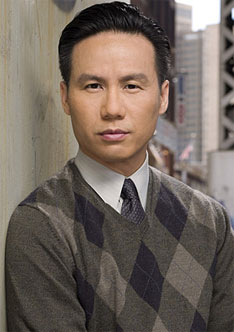
Happy with BD Wong role lately

We were so excited to see BD Wong given more meaty roles lately on Law & Order: SVU. He had very substantial roles in the episode involving child pornography and also the one involving a therapist who controlled the minds of teenage children. We look forward to seeing him in future substantial roles as opposed to his usual role of offering brief psychological interpretations in a single scene. Maybe someday he'll also be given a scene opposite Joel de la Fuente, who is also a great actor!

We wrote a letter to the show runner to express our excitement at Wong being featured. If you'd like to do the same, feel free to send it to:

Mr. Dick Wolf
Creator, Law & Order: SVU
Wolf Films, Inc.
5801 West Side Avenue
North Bergen, NJ 07047

Friday, November 13, 2009

MANAA and JACL meet with Paramount


From JACL:
(Left to right: Bill Imada, Katie Martin Kelly, Guy Aoki, Adam Goodman, Craig Ishii, Floyd Mori)

On Thursday, the JACL was represented at a meeting with Paramount Pictures by Floyd Mori, National Executive Director, and Craig Ishii, Regional Director of the Pacific Southwest District. Paramount Pictures President and CEO, Adam Goodman had invited Mori to meet to discuss problems of racial stereotyping and racial casting by Paramount. Bill Imada, CEO of the IW Group (formerly Imada Wong Communications Group), and Guy Aoki, co-founder of MAANA (Media Action Network for Asian Americans), also attended the meeting that included Paramount executives, Sharon Keyser and Katie Martinelli. The meeting was a result of a letter Mori wrote to Goodman condemning the negative stereotype portrayed in the Paramount movie, The Goods: Live Hard, Sell Hard.

Goodman, who became the CEO of Paramount after the filming of the movie, had apologized for the racially demeaning scene and with this meeting had made good on his promise to meet with Mori and other community leaders. In the meeting Goodman committed to further dialog and requested that ongoing meetings be held to monitor and evaluate Paramount's performance in providing a diverse platform in their productions.

Mori was pleased with the outcome of the meeting and stated, "Adam Goodman was receptive to our concerns and expressed an attitude of further cooperation to make Paramount a model for reflecting the diversity that exists in contemporary society. We look forward to a close working relationship with the studio in eliminating the perpetuation of negative stereotyping of ethnic minorities. Through this dialog, we hope to avoid the type of debacle which resulted from The Goods."

Saturday, October 10, 2009

Letter regarding "The Weapon"

MANAA recently heard that David Henrie, a white actor, had been cast in the film version of "The Weapon" as the Asian American hero Tommy Zhou (thanks, folks at Racebending!). It was frustrating to hear that yet another opportunity for an Asian American lead actor had disappeared, and we wondered what was to become of the strong elements of Asian American issues that had characterized the comic book. We are hoping that there is still a chance that the part will be given to an Asian American man, or that the Asian American elements of the story can still be heard.

----------------------------

October 2, 2009

Randy Greenberg
Platinum Studios, Inc.
11400 West Olympic Blvd, 14th Floor
Los Angeles, CA 90064

Dear Mr. Greenberg:

I’m writing on behalf of the Media Action Network for Asian Americans (MANAA) because we heard about the recent casting news for your film adaptation of “The Weapon.” We are a non-profit organization dedicated to monitoring the media and advocating for balanced, sensitive, and positive depiction and coverage of Asian Americans. Since 1992, we have consulted with movie studios and met regularly with the top four TV networks to convey the importance of diversity. To the point, it was extremely disappointing to learn that Tommy Zhou, the Chinese American main character from “The Weapon,” is being made into a Caucasian lead for your movie, and we would like to request a meeting to talk about these concerns with you.

You might be familiar with the controversy over the movie casting for the live-action adaptation of Nick-elodeon’s “Avatar: The Last Airbender.” While the original show was clearly inspired by Asian and Inuit influences and populated with Asian characters, Paramount cast three of the four main characters with Caucasian actors (initially it was all four). There has been a tremendous backlash from fans of the show, resulting in lost goodwill and support for the movie (e.g. www.racebending.com). Although The Last Airbender will not be in theaters until 2010, we’ve already seen one other movie tank at the box office after deviating from the source material and ethnic characters: Dragonball Evolution.

There have been signs of progress over the years. For example, Disney includes an Asian American character in the movie Up, and in various Disney Channel programs. Nevertheless, the Asian American community, as well as the movie-going public at large, are generally used to seeing Asian men depicted as villains. We rarely have the opportunity to see Asian American heroes we can celebrate.

We urge you to reconsider the decision to turn Tommy Zhou into a Caucasian character. Audiences do support diverse casting, as well as compelling stories of minority heroes like Tommy, whose Asian heritage is integral to the plot itself. You have the opportunity to break down barriers and do something historic. Platinum Studios can also avoid doing a disservice to the fans, as Paramount has done with Avatar.

We are more than glad to be a resource to you, and invite you to have a meeting with us. We would like to have a dialogue and help make The Weapon a movie that comic book and superhero fans will be excited to see.

Sincerely,

Phil Lee
President

Friday, September 18, 2009

What happened after the Paramount Protest?

For those who want to know what's been going on with Paramount and "The Goods" -- Paramount sent a written apology to the Japanese American Citizens League (JACL) right before the protest happened. Though the protest went on as planned, Paramount deserves some credit for actually responding with an apology, and a pretty well-written one at that (see below).

What's really cool is Paramount and JACL agreed to have a meeting in the future. MANAA believes that not only will this be a chance to talk to Paramount about The Goods, but also The Last Airbender!


Date
: Fri, 21 Aug 2009 14:42:24 -0700
To:
Subject: The Goods

Dear Mr. Mori:

Thank you for your recent letter regarding ‘The Goods: Live Hard, Sell Hard.’ At Paramount, we take these concerns very seriously.

On behalf of the studio, I want to extend our sincerest apologies to the Japanese American Citizens League and the greater Asian-American community for the racially demeaning language used in scenes depicted in the film. While this film is intended to be an extreme satirical comedy, it was never the objective of the producers or the studio to single out any one group for ridicule or to promote hurtful, racially disparaging language. We genuinely regret the use of this language in the film.

We’ve discussed your concerns, at length, with the producers and we have discontinued online promotion of the red-band, age-gated trailer that depicts this scene. The general audience, green-band trailer has also been pulled out of theaters.

We appreciate you bringing to our attention the concerns of the Japanese-American community and the broader Asian-American community. We truly regret any anguish that this film may have caused. We assure you that this was never the intention of the producers or the studio.

At Paramount, we would welcome a continuing dialogue over the next several weeks with you and other leaders of the Asian-American community. Again, on behalf of Paramount and Paramount Vantage, we hope you accept our sincerest apologies.

Yours truly,
Adam Goodman


Monday, September 14, 2009

MANAA Scholarship for Asian American filmmakers

FOR IMMEDIATE RELEASE

CONTACT: (909) 869-3899

MANAA Announces Its Seventh Media Scholarship

LOS ANGELES- MANAA, the Media Action Network for Asian Americans, is pleased to announce its $1000 scholarship for currently enrolled graduate and undergraduate students interested in pursuing careers as filmmakers and in television production (not broadcast journalism). Formed in 1992, MANAA is the only organization solely dedicated to monitoring the media and advocating balanced, sensitive, and positive depiction and coverage of the Asian American community.

MANAA recognizes the urgent need to fill the ranks of television and film with persons of Asian descent in decision-making positions as screenwriters, directors, producers, and studio executives. We are looking to award students who have a strong desire to advance a positive and enlightened understanding of the Asian American experience in the mainstream media.

Scholarship recipients will be selected on the basis of their academic and personal merit, desire to uplift the image of Asian Americans in film and television as demonstrated in their essay, potential as demonstrated in their work sample, and financial need.

The deadline for submission is Friday, October 30, 2009.

STUDENTS MUST SUBMIT THE FOLLOWING MATERIALS. INCOMPLETE APPLICATIONS WILL NOT BE ACCEPTED.

1. A copy of all official transcripts.

2. Two letters of recommendation, one that evaluates academic and artistic aptitude and another that speaks to the student’s interest and involvement in the community.

3. A double-spaced essay consisting of no more than 1,000 words addressing the following items: Describe your involvement in the Asian/Pacific Islander Community. How does this involvement influence your creative work? How do you think your creative work will influence the API community in the next five to ten years?

4. A work sample consisting of a short film or screenplay. Materials will not be returned.

5. A statement of special financial need or hardship.

6. A resume of both your work history and your community involvement.

Send all completed applications to MANAA Scholarship, P.O. Box 11105, Burbank, CA 91510. Please do not send applications via certified or registered mail.

For more information about MANAA and our monthly meetings, please visit the MANAA website at http://www.manaa.org. You can also visit our Facebook or MySpace account sites at http://www.facebook.com/group.php?gid=14661828412 and http://www.myspace.com/manaala, or our blog at http://manaa.blogspot.com. Any questions regarding the scholarship should be directed to scholarship@manaa.org or (213) 486-4433.

Friday, August 21, 2009

MANAA on KABC-TV


Asian American coalition protests Paramount and 'The Goods'!


Thanks so much to everyone who came out to support us with our protest at Paramount. It was a stunning success, with over 40 protesters and of course lots of supportive horn honking and a few tv station trucks to boot.


We rallied with cheers of "The Goods were rotten, that's why no one bought them!" and "Your humor is tasteless, stop being racist!" Eric and Sylvia came up with some great chants and were great chant-leaders!


Dariane from Racebending showed awesome support and helped to organize, which was great since Paramount is the studio behind the whitewashed "The Last Avatar" as well. We look forward to working with Dariane and all of the folks at Racebending on future activist endeavors!


Floyd Mori, executive director of JACL, brought a squadron of protesters and was interviewed by Channel 7 News along with MANAA's Guy Aoki.


IW Group, Inc. also sent a huge group of supporters and as well as provided materials for the posters and space to create them.

And boy did we have a lot of posters! Some favorites -- "Hate Crimes Aren't Funny" and "The Goods are Bad".


Thanks again for all the support, we think that Paramount is starting to get the picture now!

Why MANAA Protests "The Goods"

Message from the MANAA President

I received a copy of the following letter addressed to the Executive Chairman of Paramount. This letter expresses, as persuasively as any press release that MANAA could issue, why the studio needs to hear about "The Goods." Not everyone is going to be convinced that MANAA and other organizations should protest this movie, but many will recognize their own anger, fear, and frustration, expressed right here.

Phil Lee
MANAA President


August 19, 2009

Mr. Sumner M. Redstone
Executive Chairman of the Board & Founder
Viacom, Inc.
1515 Broadway
New York, NY 10036

Dear Mr. Redstone:

As an American of Japanese ancestry, I am writing to express my extreme outrage over a scene in Paramount Vantage's comedy "The Goods: Live Hard, Sell Hard" depicting the use of a racially offensive slur followed by a physical attack against an Asian American character in the film.

The scene in question, broadcast across the country in the film's trailer and now playing nationwide, shows the character, played by Jeremy Piven, giving his used-car sales team a pep talk. The Piven character then says, "Don't get me started on Pearl Harbor-the Japs flying in low and fast. We are Americans and they are the enemy! Never again!"

A man looks at the Asian American character and says, "Let's get him!" which results in a mob of men beating the Asian man. Piven's character then says, "All right, stop! We have all just participated in a hate crime. Let's get our stories straight. Dang came at us with a samurai sword, fire extinguisher and Chinese throwing stars."

This is supposed to be funny? Ask the family of Vincent Chin, who was brutally beaten to death by two out-of-work auto workers who mistook him for being Japanese during the height of "Japan bashing" during the early 1980s. Ask them if this is funny. Ask the thousands of Americans of Japanese ancestry who were called "Japs" all their lives growing up, and were later unjustly racially-profiled and incarcerated after the bombing of Pearl Harbor into American concentration camps for up to four years during WWII. Ask them if this is funny.

Using the word "Jap" is equivalent to the use of the "N-Word" when referring to African Americans. The use of the word alone is offensive enough. To combine it with the beating of an Asian character is absolutely outrageous and unacceptable in
today's media. Imagine if this scene were to take place against an African American.
The African American community would not stand for it. And neither should we.

Earlier this week, the National Office of the Japanese American Citizens League voiced its strong objection to this scene, and called on Paramount Pictures to apologize to the Japanese American and Asian American communities nationwide.

Paramount has responded by saying "The Goods satirizes and exaggerates the extremes of the sales and celebrity culture" and "is in no way meant to be mean-spirited, disparaging or hurtful to any individuals and we regret any offense taken. We understand that when presented out of context, jokes and situations in the movie about a variety of topics might be offensive to some people."

This does not sound like an apology to me. In fact, it fits conveniently into the category of "You people need to get over yourselves-can't you take a joke?"

As Chairman and Founder of an international media conglomerate which includes Paramount Vantage, you are well aware of the power of both the written and spoken word, and how words can uplift, move and literally change the world, and the people in it. You also know that words, when used in a negative, mocking way, have the same power to insult, denigrate, and can cause unthinkable damage to our psyche, our spirits, and the world we live in.

I grew up in San Francisco, California and when I was in junior high school I heard words and phrases such as "Ching Chong Chinaman," "Jap" and the like from fellow classmates who took great joy in taunting me. And I can tell you, as I stood by and took this verbal abuse, I also remember other kids standing by and laughing at me, pointing at me, and saying things like "Why are your eyes so tight? Why don't you open your eyes?" Unless you stand in my shoes, and feel the humiliation of being singled out and ridiculed solely because of my race, you cannot understand what
I-and people of Asian ancestry have gone through in this country since we first came here over 150 years ago. I can tell you this: It hurt me deeply, and it's a pain that I carry with me to this day.

These are the power of words, and how when they are abused-especially in film and television-can perpetuate hate, which can lead to more hateful words and mocking of Japanese and other Asian Americans, which can lead to hateful acts of violence and going one step further, murder.

As you can see, this is no laughing matter. May I remind you of Viacom's Global
Business Practices, which on pages 23-24, states to your employees: "Therefore, you may not: Make inappropriate statements concerning a person's race, religion, color, sexual orientation, nationality, ethnic origin, disability, age, gender, sex, gender expression, etc."

I'm assuming these practices extend to the products your company produces, and I'm assuming these words mean more to you than mere words on a piece of paper.
Therefore, I am asking you to do all in your power to edit or remove this scene from the film, and see to it that scenes such as these-that denigrate any racial group-do not happen again in the future.

Thank you for your consideration.

Sincerely,


Soji Kashiwagi

cc: Philippe P. Dauman, President & Chief Executive Officer, Viacom, Inc.
Adam Goodman, President, Paramount Films Group
Gary Sanchez, President, Gary Sanchez Productions
Floyd Mori, National Executive Director, Japanese American Citizens League

Thursday, August 20, 2009

Join our protest!!

MANAA and other Asian American activist groups will be protesting the film 'The Goods' TOMORROW at Paramount.

Join us at 4:30pm, Friday Aug 21
Paramount Studios
5555 Melrose Ave.
Los Angeles, CA

We believe that the film condones the beating of Asian Americans and makes light of hate crimes.

Please email us at letters@manaa.org if you are planning on joining us, we need all the help we can get!!!!

Sunday, August 16, 2009

MANAA condemns Asian-bashing in 'The Goods' as harmful, not funny

Los Angeles -- A scene from Jeremy Piven's new comedy "The Goods" has incensed Asian Americans, who find the beating of Ken Jeong's character frighteningly reminiscent of real violence perpetrated against Asian Americans.

"MANAA contacted Paramount to request a chance to screen the film. We tried to give them the benefit of the doubt that seeing the whole movie could somehow salvage this scene. But we received no response," said Phil Lee, President of the Media Action Network for Asian Americans.


The scene in question, which has been widely promoted in trailers, begins with Jeremy Piven riling up his car sales team by saying, "Don't even get me started on Pearl Harbor -- we are the Americans, and they are the enemy. Never again!" The other workers start shouting "Never again!" as the single Asian American, played by Jeong, joins in but looks nervous. Then the crowd turns on him and begins a violent assault that visibly injures him. Piven's character also uses the racial slur "Japs" -- an insult that goes doubly unpunished since Jeong later tells everyone he is Korean, as if the attack would be acceptable if only he were really Japanese.

While the scene is played for comedy, the threat of physical violence against Asian Americans is all too real. December 7, the day of the attacks on Pearl Harbor, is commonly dreaded by members of the Japanese American community and the wider Asian American community. Many Asian Americans have been subject to slurs and verbal assaults on this day, and there is a widespread fear that individuals who still harbor anger against the Japanese will erupt in physical violence.

The scene showing the beating of Ken Jeong by auto workers is also painfully evocative of the killing of Vincent Chin in 1982. Chin was a 27-year old Chinese auto worker in Michigan who happened to be at the same bar as two white auto workers who felt that the Japanese were to blame for the loss of their jobs. They beat him with a baseball bat, and he died from the injuries. The scene in the movie similarly confuses Japanese individuals from Japan with all individuals of Asian descent. Even so, this does not justify retributive violence for an event that occurred during a war nearly 70 years ago.


"MANAA believes that this scene should be removed from the trailers, and asks that Paramount apologize and acknowledge the concerns of our community," said Lee. "The fact it is a comedy makes it worse, because the anti-Asian violence is downplayed as harmless. Playing a hate crime scene for laughs or satire doesn't automatically protect it from being offensive."


MANAA is the only organization solely dedicated to monitoring the media and its depiction and coverage of Asian Americans.